
#What is The Safety Pyramid?
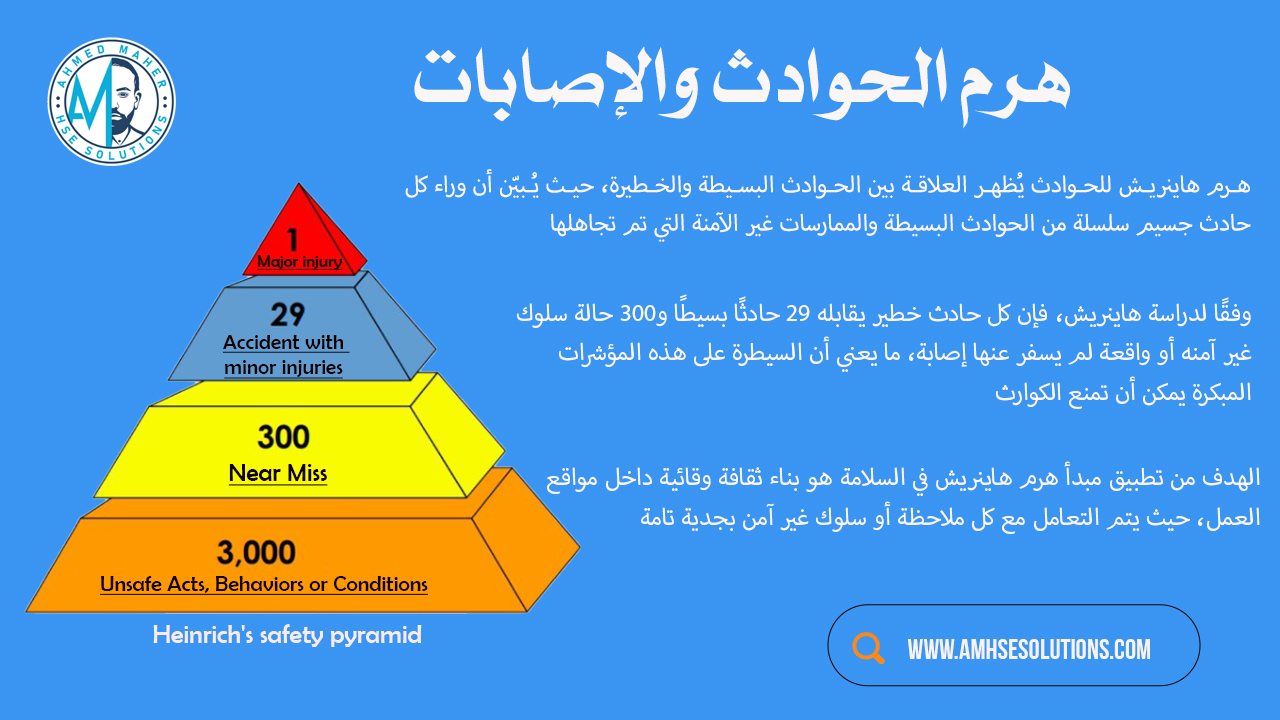
The Safety Pyramid is a hierarchical model that shows the proportional relationship between:
Near Misses
Minor injuries or small accidents
Major injuries and fatalities
One of the most famous versions of this pyramid was developed by American researcher H.W. Heinrich in the 1930s, which proposes the following ratio: Heinrich’s ratio (1:29:300)
1 Major Injury
29 Minor Injuries
300 Near Misses or Unsafe Behaviors
For every serious injury or fatality, there are usually 29 minor injuries and 300 near misses. Heinrich's findings suggested that by controlling the high frequency of less severe events—such as unsafe acts and near misses—we can reduce the likelihood of more severe accidents at the top of the triangle.
According to this model, every major injury is often preceded by a large number of small indicators that must be paid attention to.
#What does this pyramid tell us?
The safety pyramid emphasizes that major accidents do not happen suddenly, but are often preceded by a series of small accidents, unsafe behaviors, or hazardous working conditions.
Therefore, if organizations focus only on preventing major accidents without addressing the root causes of minor ones, they may miss critical opportunities for early prevention.
#Benefits of using the Safety Pyramid in Risk Management
Proactive Risk Management
Investigating near misses and minor injuries helps discover and address risks early before they escalate.Enhancing Safety Culture
Encouraging employees to report unsafe behaviors creates an aware and responsible work environment.Improving Management Decisions
Analyzing all types of incidents provides accurate data that helps management make risk-based decisions.Reducing Costs
Preventing major accidents reduces costs associated with treatment, compensation, and work stoppages.
#Modern Criticisms and Developments
Despite the importance of the safety pyramid, some experts believe it oversimplifies matters, as not all near misses necessarily lead to major accidents, and some serious accidents can occur without any clear precursors.
Therefore, many specialists recommend integrating the safety pyramid with modern tools such as:
Root Cause Analysis (RCA)
Behavior-Based Safety (BBS)
Safety Management Systems (SMS)
This is to achieve a more accurate and effective holistic approach that focuses on organizational culture, leadership, and continuous improvement.
#Conclusion
The safety pyramid is a powerful visual tool that helps organizations understand the relationship between minor and serious incidents. By promoting a culture of early reporting and taking preliminary indicators seriously, major accidents can be reduced, building a safer and more sustainable work environment.